
AAAA Weed Grades Explained: What Do Cannabis Grades Mean in Canada?
Cannabis letter grades vary between sellers. Learn how to separate informal retail descriptions from actual product labels, quantities and documented batch test results.
What Do Cannabis Grades Mean in Canada?
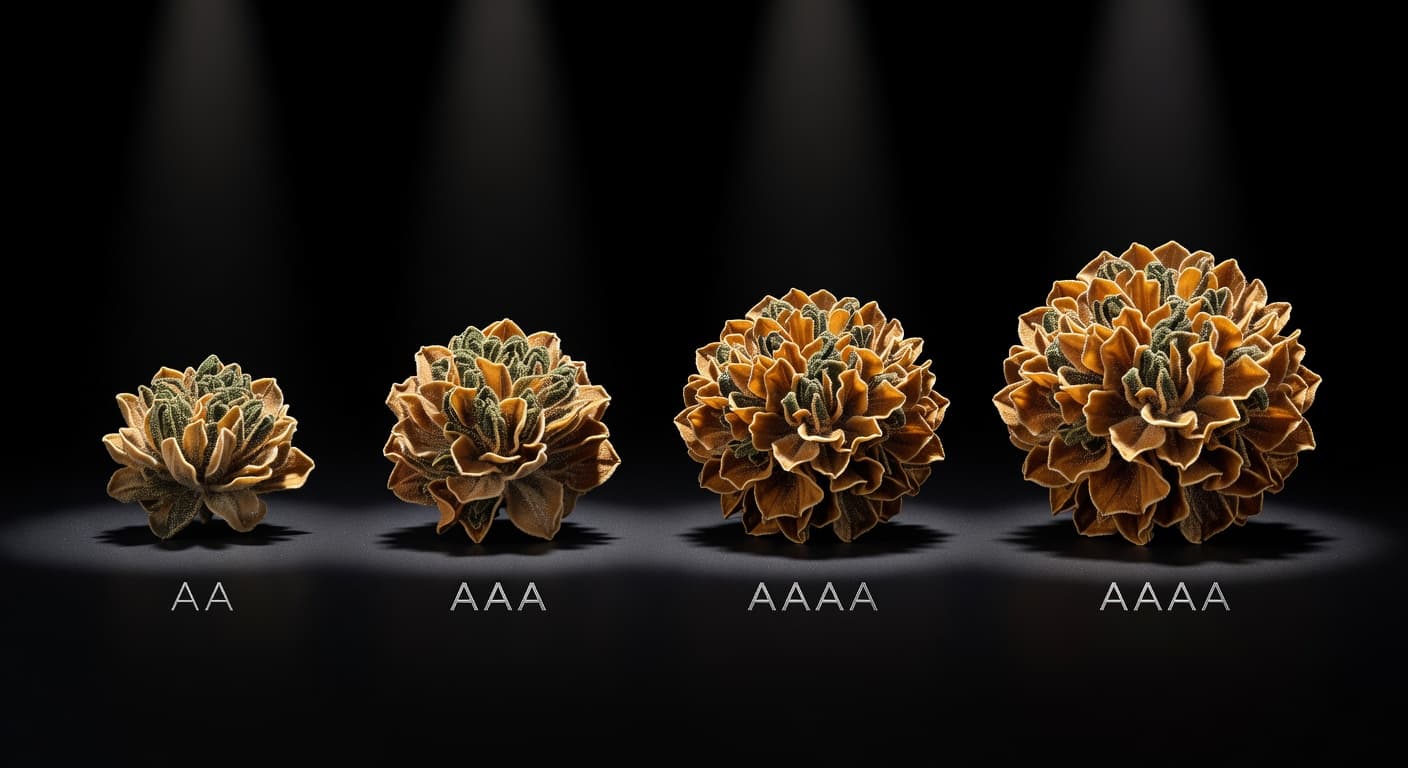
A, AA, AAA and AAAA are informal retailer descriptions of cannabis flower. AAAA is often called quad or top shelf. These terms can help describe how a seller positions a product, but the criteria vary between sellers and batches.
Treat a grade as the seller's description. It does not establish a THC percentage, contaminant result, growing method or safety guarantee. Ask how the seller assigns the grade and what information supports the specific product listing.
This guide explains common uses of the labels and the questions to ask about them. It is not an independently validated grading standard or evidence that every Mohawk Medibles product has undergone a particular test.
The Four Cannabis Grades
The descriptions below are examples of retail terminology. They are not universal specifications, laboratory findings or promised characteristics of every product in a tier.
A Grade (Single A) — Budget / Value
A seller may use A for a budget listing, smaller buds or less detailed trimming. Read the actual description: size, appearance and price alone do not establish cannabinoid content or product safety.
AA Grade (Double A) — Mid-Range
AA may describe a seller's mid-range selection. Ask which appearance, trimming or aroma characteristics led to that label and whether the product photos represent the current batch.
AAA Grade (Triple A) — Premium
AAA often signals a seller's premium tier, with emphasis on presentation, trimming or aroma. Those are subjective descriptions. There is no THC range assigned to AAA in this guide.
AAAA Grade (Quad) — Top Shelf / Craft
AAAA usually denotes the seller's highest advertised tier. It does not establish that the product comes from a small-batch grower, has no imperfections or belongs to a measured top percentage of all cannabis. Any specific craft, origin or testing claim needs its own evidence.
What You Can Observe — and What Needs Records
Appearance and Trim
Photos can help you compare bud size, visible leaf material and presentation. Ask whether the images show the batch for sale. Colour and visible trichomes do not supply a laboratory result or prove a cultivation history.
Aroma and Texture
Aroma and texture descriptions can communicate preferences, but they cannot quantify cannabinoids, identify contaminants or establish safety. Sticky or dense flower should not be treated as proof of potency. A musty smell or suspected mould is a reason to stop using the product and contact the supplier, not to try a taste or burn test.
Moisture and Storage
Ask for the product's storage instructions. Relative humidity measures moisture in the surrounding air; it is different from measured flower moisture content. A container-air reading is not a batch moisture test, and this guide does not assign a universal humidity target to a grade.
For practical handling and secure storage, see our cannabis storage checklist.
Ash and Smoke
This guide does not use white or black ash as proof of flushing, curing quality, residual nutrients or contaminant status. Descriptions such as smooth or harsh are subjective experiences and cannot substitute for a relevant test report. Do not smoke a suspect product to assess its quality.
Read Cannabinoid Values Separately from the Grade
Compare the actual product information rather than estimating potency from the number of A's. Health Canada's label guide explains Total THC and Total CBD values on legal cannabis product labels, including amounts by weight, unit or package.
Check the units and what they refer to before comparing products. For example, mg/g describes an amount per gram, while mg per unit describes an amount in an individual piece. Keep the lot number and packaging date with the product so a record can be matched to the batch.
A higher labeled THC value does not establish a higher retail grade, a preferred sensory experience or a particular outcome for every person.
Questions to Ask About a Test Report
If a product is advertised as tested, ask for a report that can be matched to the lot you are considering. Check:
Read the scope of the record. A result for one sample does not document every product or every batch. Without matching records, a retail grade or a quality slogan cannot substantiate independent potency verification, full terpene profiling or contaminant screening.
Common Grading Myths
Myth: Every AAAA Product Has a Particular THC Percentage
There is no grade-specific THC range provided here. Compare the current product's labeled value and any matching report instead of assuming that AAAA means a particular percentage.
Myth: Every Seller Uses the Same Criteria
Seller terminology varies. Ask for the grading criteria and compare the actual product details rather than comparing letter grades alone.
Myth: AAAA Guarantees a Better Experience Than AAA
Preferences differ, and the grade describes the seller's positioning. It cannot guarantee taste, smoothness, effects or suitability for a particular person.
Myth: A Quality Label Means Every Batch Is Independently Tested
A named quality programme needs supporting records and a clear scope. Do not infer universal batch testing from a programme name, the grade or a general marketing claim.
Price, Quantity and Value
Compare the current listed price, package weight and available product details. Price and quantity vary; fixed price bands by grade can quickly become misleading.
A quarter pound equals 4 ounces. That is a unit conversion, not a statement that a particular size is currently offered. Check the actual product options and net weight before ordering. This guide does not promise a specific bulk size or discount.
Browse the current flower collection for available products and quantities.
A Checklist for Comparing Listings
Sources and Further Reading
Reviewed on October 13, 2026. The retailer terminology above is separate from Health Canada's label and storage guidance. Those sources do not endorse a letter-grade scale or verify Mohawk Medibles products.